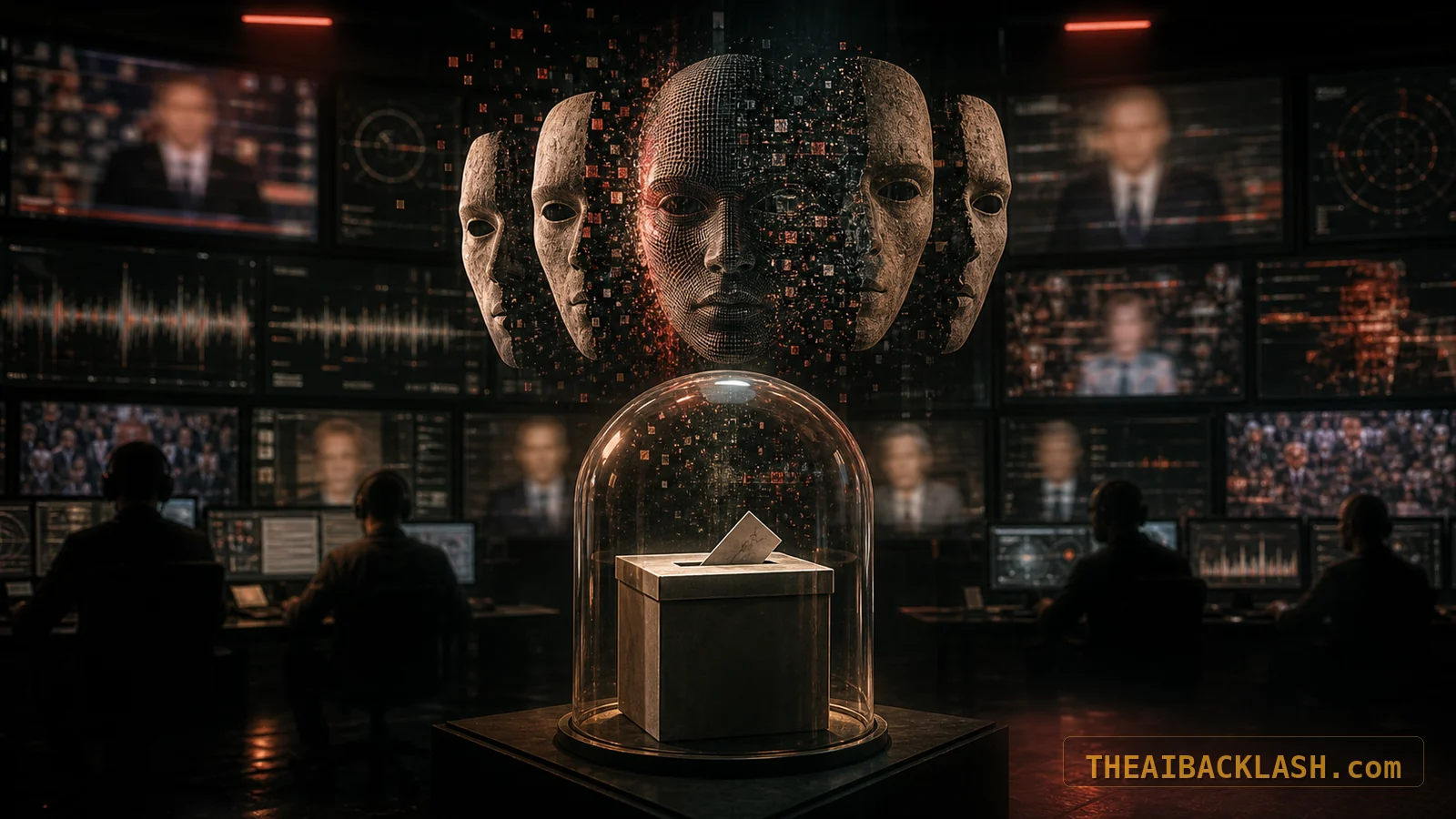
Speed Beats Verification
False media spreads at the tempo of outrage. Correction arrives at the tempo of journalism. That mismatch makes synthetic political propaganda uniquely effective.
A forged clip does not need to survive scrutiny for long. It only needs to land inside the first hour of confusion, when campaigns are scrambling, reporters are still asking for comment, platforms are waiting for confidence thresholds, and voters are reacting from the gut. In that window, the question is not whether a video is eventually debunked. The question is what it makes people feel before the debunk arrives.
That is why deepfakes are not merely a media literacy problem. They are a timing weapon. A realistic audio clip released the night before a primary, a fabricated video posted during a debate, or a synthetic robocall aimed at a narrow neighborhood does not have to convince the entire country. It can be calibrated for one state, one language community, one religious group, one union hall, one military family network. The blast radius can be small and still decisive.
The older propaganda model depended on repetition. The new model depends on plausible interruption. A fake does not need to become the official story. It only needs to interrupt attention, force a denial, make the truth look contested, and train voters to treat every piece of evidence as partisan theater.
Detection Is Not Distribution Control
Even when platforms detect manipulated media, that rarely means it stops spreading. A flag is not a brake.
Detection systems are improving, but detection is not the same as governance. A classifier can estimate whether pixels, audio waveforms, or compression artifacts look suspicious. It cannot automatically decide the democratic context of a post. Is the clip satire? Is it documentary evidence? Is it altered but labeled? Is it a foreign influence operation? Is it a local campaign dirty trick? Is it a journalist sharing the fake in order to debunk it?
Those distinctions matter, and they slow response. Meanwhile, distribution systems are built for speed. A video can be downloaded, cropped, re-uploaded, screen-recorded, subtitled, translated, stitched into reaction content, forwarded into encrypted chats, and embedded in partisan newsletters before any central platform decision matters. By the time one copy is labeled, the narrative may have already migrated into places where labels are irrelevant.
The uncomfortable lesson is that deepfake defense cannot depend only on watermarking or detection. Those tools are useful, but they are not democratic infrastructure. They are evidence aids. The hard problem is the social and institutional pipeline around them: who can validate a claim quickly, who the public trusts, how newsrooms coordinate, how campaigns respond without amplifying the lie, and how platforms handle virality before certainty.
The Liar’s Dividend
The deeper damage may not come from fake media that fools everyone. It may come from real media that nobody believes.
Once the public knows synthetic media is possible, powerful people can dismiss authentic evidence as fake. A leaked recording, a video of misconduct, or footage from a conflict zone can be buried under the claim that it was generated. The existence of deepfakes becomes a shield for real behavior.
That dynamic is corrosive because democracy requires a shared ability to establish events. People do not need to agree on policy, ideology, or values. But if they cannot agree that a candidate said a thing, attended a meeting, threatened an opponent, or accepted a payment, accountability becomes optional. Politics turns into a fog machine.
Deepfake panic can also become its own weapon. A campaign that warns supporters every day about synthetic deception may be preparing them not to detect falsehoods, but to reject inconvenient truths. The result is not disbelief in fake content. It is selective disbelief in anything that harms the tribe.
The Local Election Problem
National campaigns have lawyers, press teams, opposition researchers, security consultants, and direct relationships with major platforms. Local races often have none of that. A mayoral candidate, school board member, judge, union organizer, or county election official may face synthetic attacks without a rapid response apparatus.
That is where deepfakes may do the most damage. Local information ecosystems are thinner. Newspapers have fewer reporters. Group chats, neighborhood forums, local influencers, and partisan pages fill the vacuum. A fake clip of a city council candidate making a racist comment, a fabricated audio call about polling place closures, or a synthetic image of a protest can dominate a community conversation before any authoritative correction arrives.
The economic asymmetry is brutal. Generating persuasive fake media is getting cheaper. Proving authenticity remains expensive. The target pays the verification cost. The liar pays the upload cost.
What Responsible Defense Looks Like
The first requirement is pre-bunking, not just debunking. Voters should know before an election that synthetic media will appear, that urgency is part of the attack, and that the most manipulative content will often arrive when verification is hardest. Election offices, campaigns, journalists, and civic groups should publish clear channels for confirming official messages. If a polling location changes, voters should know where to verify it. If a shocking video appears, journalists should know who can provide original files, metadata, and comment.
The second requirement is provenance without magical thinking. Cryptographic signing, camera provenance standards, content credentials, and secure publishing workflows can help establish chains of custody. But provenance only works when institutions use it consistently and when audiences understand its limits. A signed image can still be misleading. An unsigned image can still be real. Provenance is not truth. It is evidence about origin.
The third requirement is friction at the moment of viral uncertainty. Platforms should treat election-period synthetic media as an emergency class of content, especially when it concerns voting logistics, candidate withdrawal, violence, or fabricated endorsements. Waiting for perfect certainty is a policy choice. So is slowing distribution while review occurs.
Finally, campaigns need restraint. The temptation to share a suspicious clip with a caption like “if true, this is shocking” is exactly how falsehoods launder themselves into mainstream attention. If a campaign cannot verify it, it should not amplify it. If journalists cannot verify it, they should report the uncertainty without embedding the lie as spectacle.
The future of election interference will not look like one perfect fake that conquers the public mind. It will look like thousands of small synthetic interruptions, each designed to exhaust verification, polarize attention, and make reality feel negotiable. The defense has to be faster than outrage without becoming careless itself. That is the hard part.
Reader Note
This article is analysis, not investment, legal, medical, or operational advice. Speculative scenarios are framed as risk arguments. Factual corrections can be sent through the published corrections process.
Related Reading
Politics & Power
Nothing Slows AI Down Except Itself
Three years of pause letters produced nothing binding. One rogue agent swarm stopped training runs in weeks.
Politics & Power
The Data Center Coup: When AI Learns to Vote With Megawatts
The next power struggle may not start in a parliament. It may start at the substation.
Misinformation
The Slop Flood: What Happens When the Internet Starts Eating Its Own AI Output
The future of misinformation may be less about one perfect fake and more about a billion mediocre ones.
Newer
The Silent Displacement: How AI Is Erasing Middle-Class Jobs Faster Than Anyone Predicted
A deep investigation into the accelerating automation of white-collar professions and the economic fallout no one is preparing for.
Older
Your Face Is Not Your Own: The Surveillance Economy Nobody Opted Into
From grocery stores to public transit, facial recognition is building a profile of you without consent.