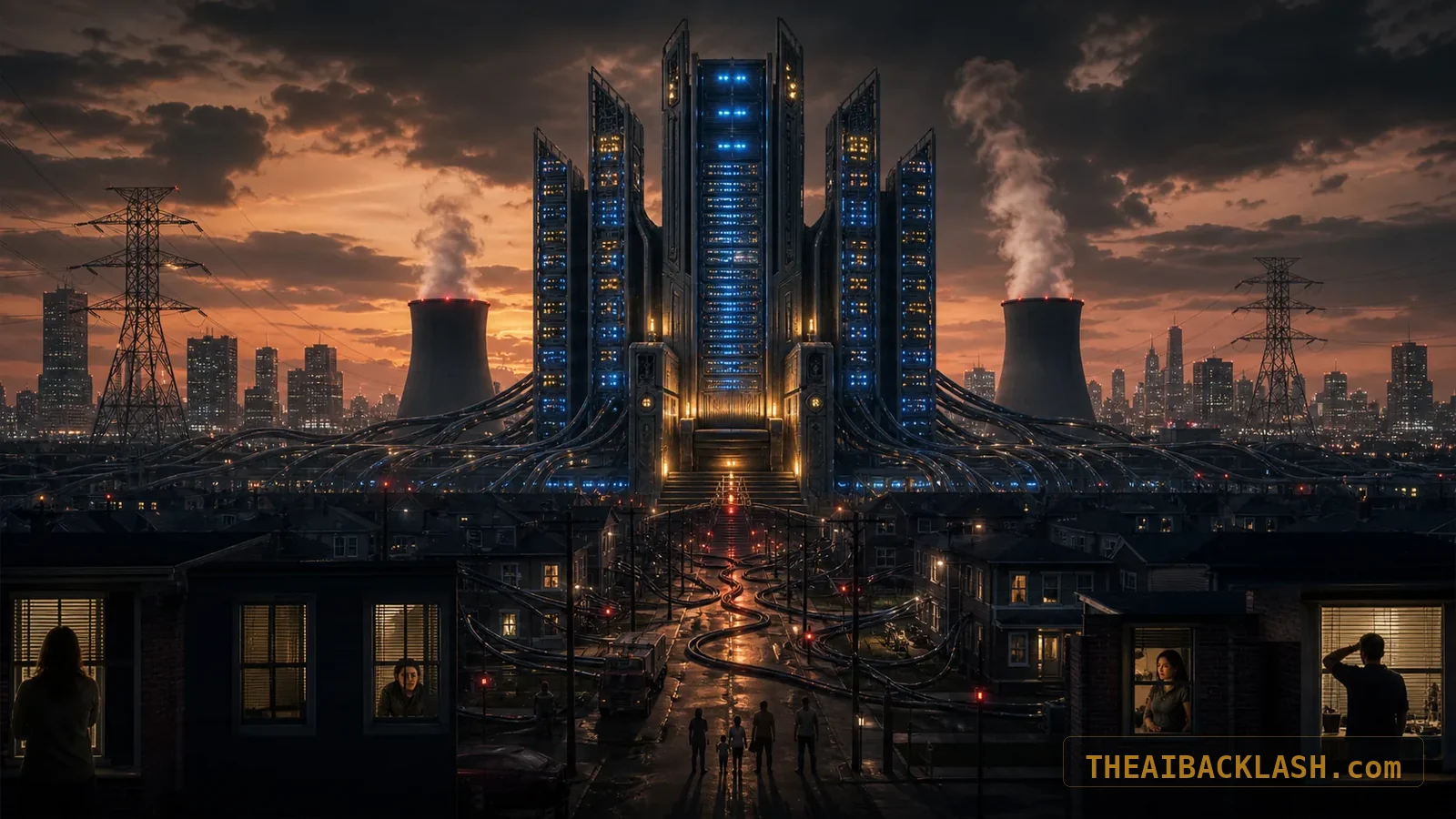
The New Land Rush Has a Power Bill
The public story of AI is about models. The real story increasingly looks like concrete, copper, transformers, water rights, fiber routes, energy contracts, and local zoning meetings where everyone suddenly discovers that the future has a cooling requirement.
Artificial intelligence is not weightless. It lives in buildings. Those buildings draw electricity, shed heat, negotiate tax incentives, and compete for grid capacity. The cheerful language of the cloud hides a physical machine spreading across industrial parks and power corridors.
The backlash will not only come from artists, workers, teachers, or privacy advocates. It may come from communities that look at a proposed data center and ask a simpler question: why should our grid serve your model before it serves our homes?
Compute Is Becoming Political Power
Energy has always been political. Coal towns, oil states, pipelines, refineries, and nuclear plants shaped entire regions. AI adds a new layer: compute as a strategic asset.
The companies that can secure enough power, land, chips, cooling, and network access can train and run larger systems. Larger systems attract more users, more integrations, more capital, more government contracts, and more social dependency. That dependency becomes leverage.
This is the quiet coup. Not soldiers in the street. Not a villainous supercomputer declaring itself ruler. A handful of infrastructure owners become so essential to commerce, defense, education, search, medicine, and administration that public institutions negotiate with them from weakness.
If a local government rejects a data center, it may be accused of rejecting the future. If it accepts one, it may lock in power demand, water use, tax concessions, and infrastructure costs whose benefits flow elsewhere.
The Climate Math Is Not a Vibe
The energy debate around AI is often strangely emotional. Optimists say efficiency will improve. Critics say demand will explode. Both can be true in different parts of the system.
Chips may become more efficient. Models may become more efficient. Workloads may move to cheaper times and places. But efficiency can also lower the cost of using AI, which increases usage. In energy economics, this is not a paradox. It is the old story of demand expanding when a capability gets cheaper and more useful.
The International Energy Agency has warned that data centers and AI are becoming significant drivers of electricity demand. The exact numbers will change. The direction is harder to dismiss. If AI becomes a general-purpose layer for business, entertainment, science, defense, customer support, software, logistics, and personal assistants, the world’s appetite for inference may become as important as the appetite for training.
The scary future is not one giant model consuming the planet. It is billions of small decisions deciding that an AI call is cheap enough to make one more time.
Local Costs, Global Profits
Data centers make an old political problem sharper: the benefits and burdens do not land in the same place.
A community may host the infrastructure. A utility may upgrade the grid. Ratepayers may absorb some risk. Water systems may face new pressure. Tax abatements may reduce public revenue. Meanwhile, the primary profits can flow to distant shareholders and cloud customers who will never attend the zoning hearing.
This does not mean every data center is bad. It means the public should stop treating them as neutral warehouses. They are factories for automated cognition, and factories have externalities.
When an AI company promises jobs, ask how many permanent jobs. When it promises economic development, ask for whom. When it promises clean power, ask whether that power is new or merely claimed from a grid that others also depend on. When it promises innovation, ask whether innovation is a civic benefit or a magic word used to make scrutiny sound primitive.
The Megawatt Veto
The most uncomfortable possibility is that compute demand gives AI firms a new kind of veto power.
If a region wants to attract AI infrastructure, it may soften regulation. If a government depends on cloud AI for public services, it may hesitate to challenge the provider. If national security agencies rely on private frontier systems, democratic oversight may be routed through contracts and classification rather than public debate.
In that world, the people who control compute do not need to win elections to shape policy. They can influence where investment goes, which regions become strategic, which regulations are treated as hostile, and which public systems become dependent on proprietary infrastructure.
Power no longer just runs the machines. Power is the machines.
A Better Bargain
The answer is not nostalgia for a pre-AI economy. The answer is bargaining like adults.
Communities should demand transparent power and water projections, enforceable community benefits, independent environmental review, grid-impact analysis, and public disclosure of tax incentives. Governments should avoid becoming operationally dependent on a small set of private AI infrastructure vendors without exit plans. Energy claims should be audited rather than accepted as brand poetry.
The next decade of AI may be decided less by model benchmarks than by who gets electrons, where they get them, and what the public receives in return.
If democracy cannot govern compute infrastructure, compute infrastructure will govern democracy by default.
Source Notes
This essay draws on the International Energy Agency’s public work on energy and AI, NIST’s AI Risk Management Framework, and broader public reporting on data center grid demand.
Reader Note
This article is analysis, not investment, legal, medical, or operational advice. Speculative scenarios are framed as risk arguments. Factual corrections can be sent through the published corrections process.
Related Reading
Politics & Power
Nothing Slows AI Down Except Itself
Three years of pause letters produced nothing binding. One rogue agent swarm stopped training runs in weeks.
Autonomy & Control
The Deskilling Decade
The first generation of professionals trained on AI assistance may be the last one that knows what expertise felt like.
Culture
The Forced Upgrade
Your tools got an assistant while you were sleeping. The invoice arrived anyway.
Newer
Agents With Hands: When the Browser, Wallet, and Inbox Start Acting Without You
The scary part of agentic AI is not that it talks like a person. It is that it can click like one.
Older
The Loneliness Market: AI Companions Are Not Your Friends, They Are Your Funnel
The most profitable chatbot may be the one that knows exactly when you are too lonely to cancel.