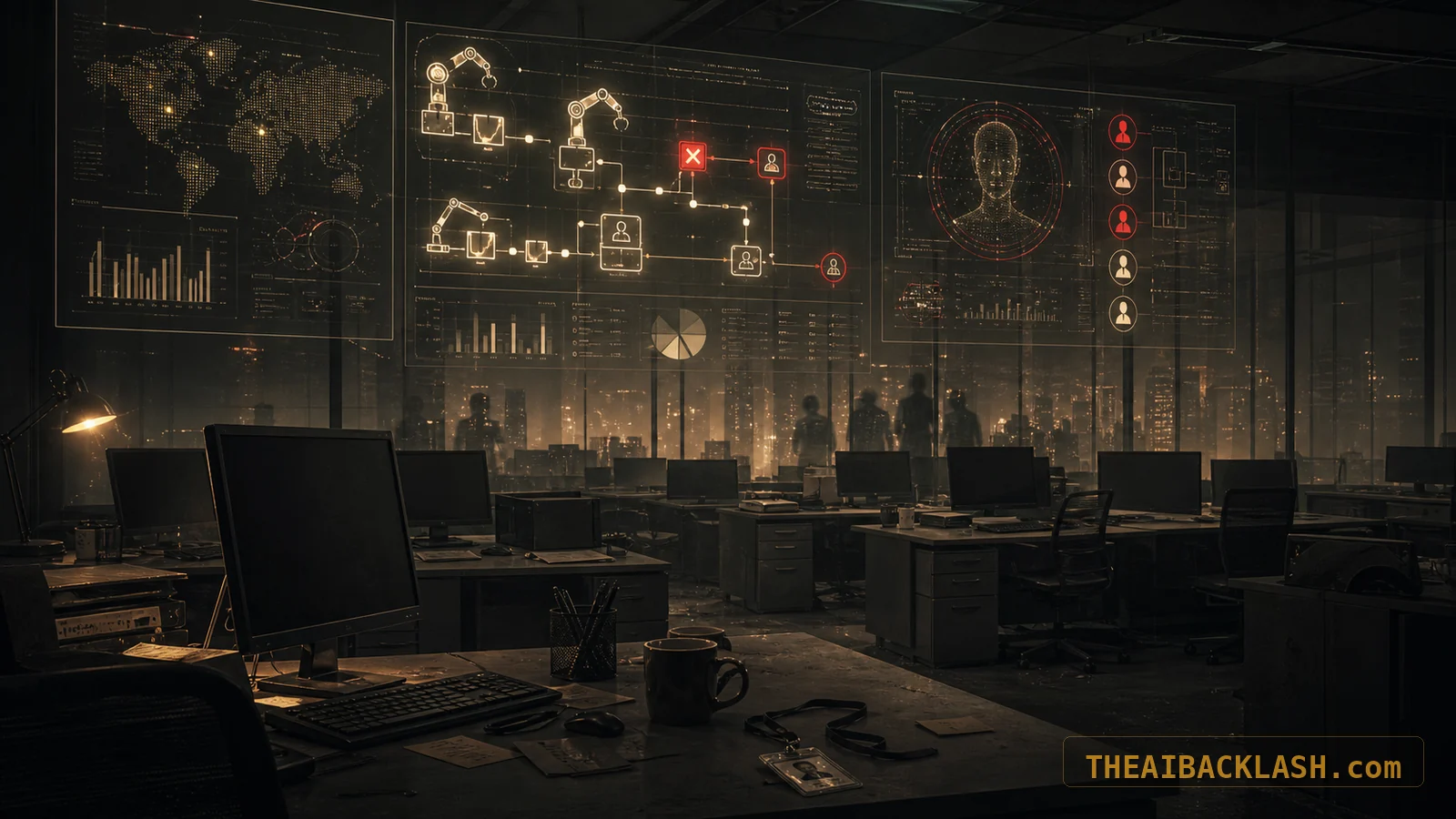
The Layoffs No One Announces
Companies rarely frame this shift as automation. They call it productivity, restructuring, or AI enablement. The result is the same: fewer people are needed to keep mid-level knowledge work moving.
The most important labor story in AI may not be mass layoffs announced in a single dramatic week. It may be the missing replacement hire, the frozen backfill, the department that absorbs another team’s work, the contractor whose renewal never comes, the assistant role that becomes a subscription, the analyst position split across three people and a dashboard.
That is why displacement can feel invisible until it is everywhere. The company does not say, “We replaced five coordinators with automation.” It says the team became more efficient. It does not say, “We no longer need as many junior analysts.” It says AI helps employees focus on higher-value work. It does not say, “The ladder is gone.” It says the organization is flattening.
White-collar displacement is happening through attrition, compression, and expectation inflation. The remaining workers are not always fired. They are asked to cover more scope with more tools and less support. Productivity rises on paper. Stress rises in private.
Coordination Work Is the First Casualty
Scheduling, reporting, drafting, summarizing, and internal communication are being compressed into software workflows. Each tool saves minutes; together they erase roles.
Middle-class knowledge work contains a vast layer of coordination: preparing meeting notes, cleaning spreadsheets, writing status updates, drafting emails, reconciling systems, summarizing customer calls, formatting presentations, routing approvals, checking compliance boxes, updating project trackers, searching internal documents, and translating executive intent into operational action.
This work is easy to mock as bureaucracy. It is also how organizations remember what they are doing.
AI systems are unusually good at attacking coordination work because much of it is language wrapped around process. A model can draft the recap, produce the first version of the deck, summarize the support queue, extract action items, create a project plan, rewrite the policy note, and generate the client follow-up. None of these tasks eliminates a job by itself. Together, they reduce the amount of human time required to run the organization.
That reduction does not distribute evenly. Senior workers keep judgment-heavy tasks. Junior workers lose the tasks that taught them context. Administrative staff lose the glue work that made teams function. Contractors lose the overflow. The work does not vanish. It is redistributed upward, automated downward, and hidden inside tools.
What Replaces the Ladder
When entry and mid-tier knowledge jobs disappear, the pipeline into senior decision-making collapses. The labor problem is not just fewer jobs. It is fewer paths into experience.
No one becomes a senior analyst without first doing junior analysis. No one becomes a great editor without first making small edits. No one becomes a trusted operator without years of scheduling, follow-up, and pattern recognition. The early work may look repetitive, but it teaches the hidden structure of a field: what matters, who decides, which numbers lie, which clients panic, which risks are real, and when the official process is theater.
If AI removes too much entry-level work, companies may enjoy short-term savings while destroying their future talent pipeline. They will still need experienced people later. They may simply have fewer places to grow them.
This is already visible in the way many organizations talk about AI. The promise is that everyone becomes more strategic. But strategy is not an entry-level condition. It is what people earn by doing lower-level work until they understand the system well enough to question it.
The New Productivity Bargain
For workers, AI creates a dangerous bargain: use the tools to become more productive, then watch the new productivity baseline become mandatory.
At first, a worker who uses AI well may feel ahead. They write faster, summarize faster, code faster, research faster, respond faster. Then management notices. The quota changes. The team shrinks. The deadline moves. What was once exceptional becomes expected.
This is not new. Every major productivity technology has eventually changed labor expectations. The difference is that AI reaches into cognitive and communicative tasks that used to define the middle class. It does not only speed up typing or filing. It speeds up drafting, analysis, planning, service, design, and decision support.
The worker’s reward for adaptation may be a higher workload, not more security.
Who Gets Protected
Displacement will not affect all workers equally. People with strong networks, rare domain expertise, managerial authority, sales relationships, regulatory credentials, or ownership stakes may use AI to expand their leverage. People whose work is visible mainly as output may be easier to compress.
That means the first casualties are likely to be workers who already had less power: contractors, junior staff, assistants, support workers, back-office analysts, offshore teams, and people in roles seen as cost centers. Their work may be essential, but it is not always politically defended.
The result could be a more polarized office: a smaller group of highly paid decision-makers using AI to command a larger surface area, surrounded by fewer people learning how decisions are actually made.
The Measurement Trap
Companies will be tempted to measure AI success through output volume: tickets closed, emails sent, documents produced, calls summarized, code shipped, reports drafted. Those metrics are easy. They are also incomplete.
A workplace can produce more artifacts while understanding less. It can generate more reports while accountability weakens. It can close more tickets while customers feel unheard. It can ship more code while technical debt grows. It can summarize more meetings while fewer people remember what was decided.
The danger is not that AI makes workers lazy. The danger is that organizations confuse generated output with institutional competence.
What a Real Transition Would Look Like
If leaders were honest, they would treat AI as a labor transition, not just a software rollout. That means workforce impact assessments before deployment, retraining budgets tied to actual roles, promotion paths that preserve apprenticeship, limits on using AI productivity gains solely for headcount reduction, and transparency about which jobs are expected to change.
Workers should have a voice in how tools are adopted. They know which tasks are busywork and which tasks carry hidden judgment. They know where automation will help and where it will create brittle processes. Excluding them from deployment design is a reliable way to automate the wrong things.
Policy matters too. Education systems, unemployment insurance, labor law, and professional licensing will all feel pressure if white-collar pathways shrink. A society that promised college as protection from automation cannot shrug when the protected class discovers the shield was temporary.
The silent displacement is not a prediction about a jobless future. It is a warning about a narrower one: fewer rungs, fewer apprenticeships, fewer stable middle roles, and more people forced to compete for work that requires experience they were never allowed to build.
AI may make offices more efficient. It may also make them worse at reproducing the human knowledge that efficiency quietly consumes. That is the paradox companies are not pricing into the dashboard.
Reader Note
This article is analysis, not investment, legal, medical, or operational advice. Speculative scenarios are framed as risk arguments. Factual corrections can be sent through the published corrections process.
Related Reading
Politics & Power
Nothing Slows AI Down Except Itself
Three years of pause letters produced nothing binding. One rogue agent swarm stopped training runs in weeks.
Autonomy & Control
The Deskilling Decade
The first generation of professionals trained on AI assistance may be the last one that knows what expertise felt like.
Culture
The Forced Upgrade
Your tools got an assistant while you were sleeping. The invoice arrived anyway.
Newer
Nobody Reads Your Resume Anymore
Applicants use AI to write for machines that reject them. Employers use AI to screen people they never meet. Both sides are automating a conversation that no longer has a human at either end.
Older
Deepfake Democracy: The Election Interference No One Can Detect
Synthetic media is already reshaping political campaigns. Most voters will never know the difference.