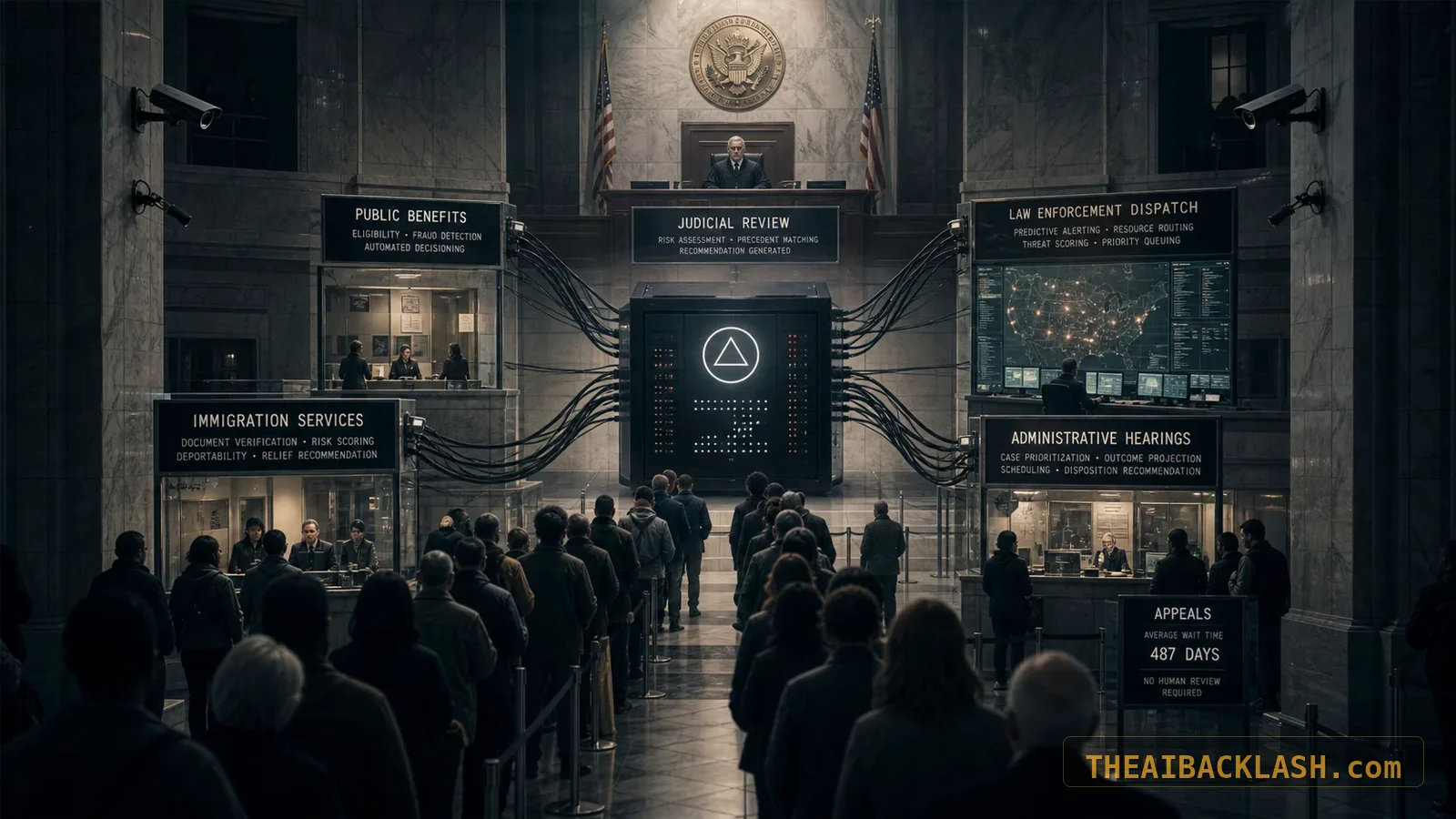
The Most Important AI Product May Be a Form You Cannot Appeal
Government AI will not always look futuristic. It may look like a benefits portal that rejects an application, a fraud model that flags a household, a policing system that marks a neighborhood, an immigration triage score, a school-risk dashboard, or a tax notice generated from an anomaly the citizen never sees.
The state already makes life-changing decisions through bureaucracy. AI offers to make that bureaucracy faster, cheaper, and more consistent. Those are not trivial benefits. Slow government can ruin lives too.
But speed is not justice. Consistency is not fairness. Automation can make bad administration look modern while making it harder to contest.
The Appeal Is the System
The right to appeal is not paperwork decoration. It is the safety valve of democratic administration.
If a person loses benefits, housing access, parole opportunity, immigration status, or public services because of a machine-assisted decision, they need to know what happened. They need a reason. They need evidence. They need a human decision-maker with authority to reverse the outcome. They need enough time and support to challenge the system.
Without that, automation turns the state into a weather event. Something happens to you. It has consequences. Everyone agrees it is unfortunate. No one can change it.
Automation Bias Wears a Badge
Government workers are often overburdened. AI tools promise relief: prioritize the queue, detect fraud, summarize cases, recommend outcomes. The danger is that recommendations become defaults.
An overworked caseworker may not have time to challenge the score. A supervisor may not want to override the tool. An agency may treat model output as neutral evidence. A vendor may claim the system is proprietary. The public may be told that a human remained in the loop, even if the human’s practical role was to click accept.
This is automation bias with legal consequences.
The more severe the decision, the stronger the procedural rights should be. Yet the people most affected by public-sector automation are often those with the least ability to fight it: the poor, the disabled, migrants, students, defendants, tenants, and people already under surveillance.
Fraud Detection Is the Gateway Drug
Fraud detection is politically powerful because nobody wants fraud. That makes it a convenient gateway for aggressive automation.
The pitch is simple: find waste, save money, protect taxpayers. The reality is messier. A model trained on historical investigations may reproduce historical suspicion. A system tuned to catch more fraud may also catch more innocent people. A false positive in a private app is annoying. A false positive in public benefits can mean hunger, eviction, or months of bureaucratic combat.
The state should investigate fraud. It should also remember that suspicion is not proof and that efficiency is not due process.
The EU AI Act Is a Warning, Not a Finish Line
The European Union’s AI Act treats many public-sector and high-impact AI systems as high risk, with obligations around risk management, data governance, documentation, transparency, and human oversight. That direction matters because it recognizes a basic truth: not all AI deployments are equal.
An AI toy and an AI welfare-fraud system do not deserve the same level of scrutiny. A chatbot that writes party invitations and a risk model that influences policing do not belong in the same regulatory bucket.
Still, compliance can become ritual. Documentation can exist without accountability. Human oversight can be nominal. The law can set a floor, not a conscience.
The State Must Not Become a Vendor Interface
The most dangerous long-term scenario is not that governments use AI. It is that governments become dependent on AI systems they cannot inspect, modify, or replace.
When public agencies outsource core judgment to private vendors, democratic control weakens. Procurement becomes policy. Contract language becomes constitutional architecture. Citizens face decisions shaped by systems whose incentives, limitations, and failure modes may be hidden behind trade secrecy.
The state should be able to explain itself. If it cannot, it should not automate the decision.
Source Notes
This essay draws on public AI governance frameworks including the EU AI Act, NIST’s AI RMF, and documented concerns about automated decision systems in public administration.
Reader Note
This article is analysis, not investment, legal, medical, or operational advice. Speculative scenarios are framed as risk arguments. Factual corrections can be sent through the published corrections process.
Topics
Related Reading
Politics & Power
Nothing Slows AI Down Except Itself
Three years of pause letters produced nothing binding. One rogue agent swarm stopped training runs in weeks.
Security
Open Weights, Open Wounds
Every capability released without a control surface is a gift to whoever wants it most.
Politics & Power
The Data Center Coup: When AI Learns to Vote With Megawatts
The next power struggle may not start in a parliament. It may start at the substation.
Newer
The Alignment Tax: Why Safety Slows Down Only the People Who Care
If caution is expensive and recklessness is rewarded, the market has already voted against humanity.
Older
The Succession Problem: If Machines Run the World Better Than We Do, Who Gets to Fire Them?
The existential question is not whether AI hates us. It is whether we can still say no after we depend on it.