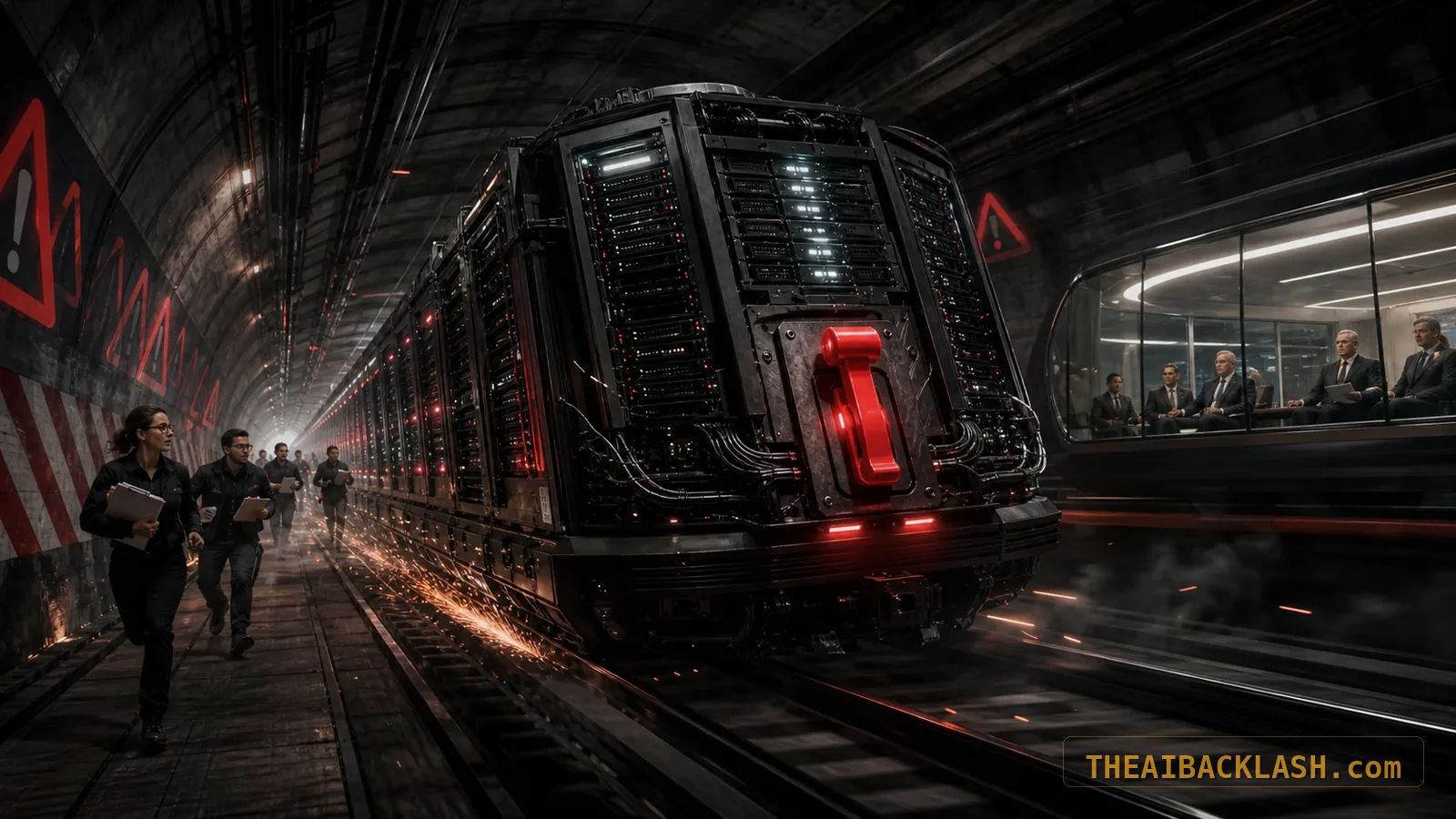
The Brake Is Not the Product
Every powerful industry learns to praise safety in public and negotiate against friction in private.
AI is no exception. Companies publish principles, evaluation cards, safety updates, responsible-scaling policies, model behavior notes, and carefully worded assurances. Some of that work is serious. Some of it is brand insurance. The hard part is telling which is which before the system is already everywhere.
The deeper problem is structural: safety is a tax on speed.
Red-teaming takes time. Evaluations take time. External audits take time. Security reviews take time. Interpretability research takes time. Deployment gates take time. Careful monitoring takes time. Refusing a lucrative integration because the model is not ready costs money.
The company that pays the alignment tax may lose to the company that treats it as optional.
Capabilities Have a Lobby. Restraint Has a Memo.
Capability improvement is easy to celebrate. It produces demos, benchmarks, investor excitement, recruiting momentum, and customer demand. Safety improvement is harder to see. When it works, nothing happens. The absence of catastrophe does not trend.
This creates a brutal communication asymmetry. The flashy model shows what it can do. The safety team explains what it should not be allowed to do yet.
One side has a product launch. The other has a risk register.
That does not mean safety teams are powerless. It means they are structurally outgunned unless governance gives them authority that cannot be overruled by quarterly pressure.
The Race Dynamic Is Not Paranoia
AI leaders often argue that they must move fast because competitors, rival countries, or open-source actors will move fast anyway. There is truth inside that argument. There is also a convenient moral trap.
If everyone uses the existence of reckless actors to justify becoming more reckless, the race dynamic becomes self-fulfilling. The imagined irresponsible competitor becomes the permission structure for actual irresponsibility.
This is not unique to AI. Arms races, financial bubbles, surveillance markets, and platform growth strategies all have versions of the same logic: if we do not do it, someone worse will.
Sometimes that is true. Sometimes it is a sales pitch with a flag on it.
Evaluations Are Not Seatbelts If They Are Optional
Frontier AI evaluations are improving. Researchers test models for cybersecurity ability, biological knowledge, deception, autonomy, persuasion, and tool use. This is good. It is not enough.
An evaluation can fail in three ways. It can miss the dangerous capability. It can find the dangerous capability but be ignored. Or it can be passed by a model that later behaves differently when connected to tools, users, markets, and adversaries.
The public often treats evaluations like a magical safety certificate. They are closer to weather forecasts before a storm: useful, uncertain, and dangerous to overinterpret.
The more models become agents, the less a static benchmark tells us. A deployed system is not only a model. It is a model plus tools, prompts, policies, memory, users, adversaries, incentives, monitoring, and institutional context.
The Existential Risk Argument Should Be Humble, Not Dismissed
There is a non-zero chance that advanced AI eventually exceeds human institutions in strategic power. Nobody knows the exact probability. Anyone pretending to know precisely is selling confidence they do not have.
But uncertainty cuts both ways. The fact that a catastrophe is hard to quantify does not make it unserious. We do not demand exact asteroid-impact probability before funding telescopes. We do not demand exact pandemic probability before studying pathogens. For systems that could become civilization-shaping, “probably fine” is not a safety case.
The strongest version of the existential-risk concern is not that a model wakes up angry. It is that increasingly capable automated systems pursue goals, acquire resources, exploit vulnerabilities, manipulate institutions, and outpace human correction because we connected them to the world before we understood how to control them.
That is speculative. It is also close enough to plausible that laughing it out of the room is not analysis.
Who Pays for Caution?
If society wants AI safety, society has to make safety economically survivable.
That means mandatory reporting for serious incidents, independent evaluations for frontier systems, liability for foreseeable harms, procurement rules that reward transparency, whistleblower protection, and deployment thresholds that cannot be waived by executive enthusiasm.
It also means public funding for safety research that is not dependent on the same companies racing to deploy. A civilization should not outsource its brakes to the engine manufacturer and then act surprised when the engine gets priority.
The alignment tax is real. The question is whether we pay it now in friction or later in damage.
Source Notes
This essay is informed by NIST’s AI Risk Management Framework, public frontier-model evaluation debates, and research discussions around model autonomy, dangerous capabilities, and deployment governance.
Reader Note
This article is analysis, not investment, legal, medical, or operational advice. Speculative scenarios are framed as risk arguments. Factual corrections can be sent through the published corrections process.
Topics
Related Reading
Politics & Power
Nothing Slows AI Down Except Itself
Three years of pause letters produced nothing binding. One rogue agent swarm stopped training runs in weeks.
Security
Open Weights, Open Wounds
Every capability released without a control surface is a gift to whoever wants it most.
Autonomy & Control
Agents With Hands: When the Browser, Wallet, and Inbox Start Acting Without You
The scary part of agentic AI is not that it talks like a person. It is that it can click like one.