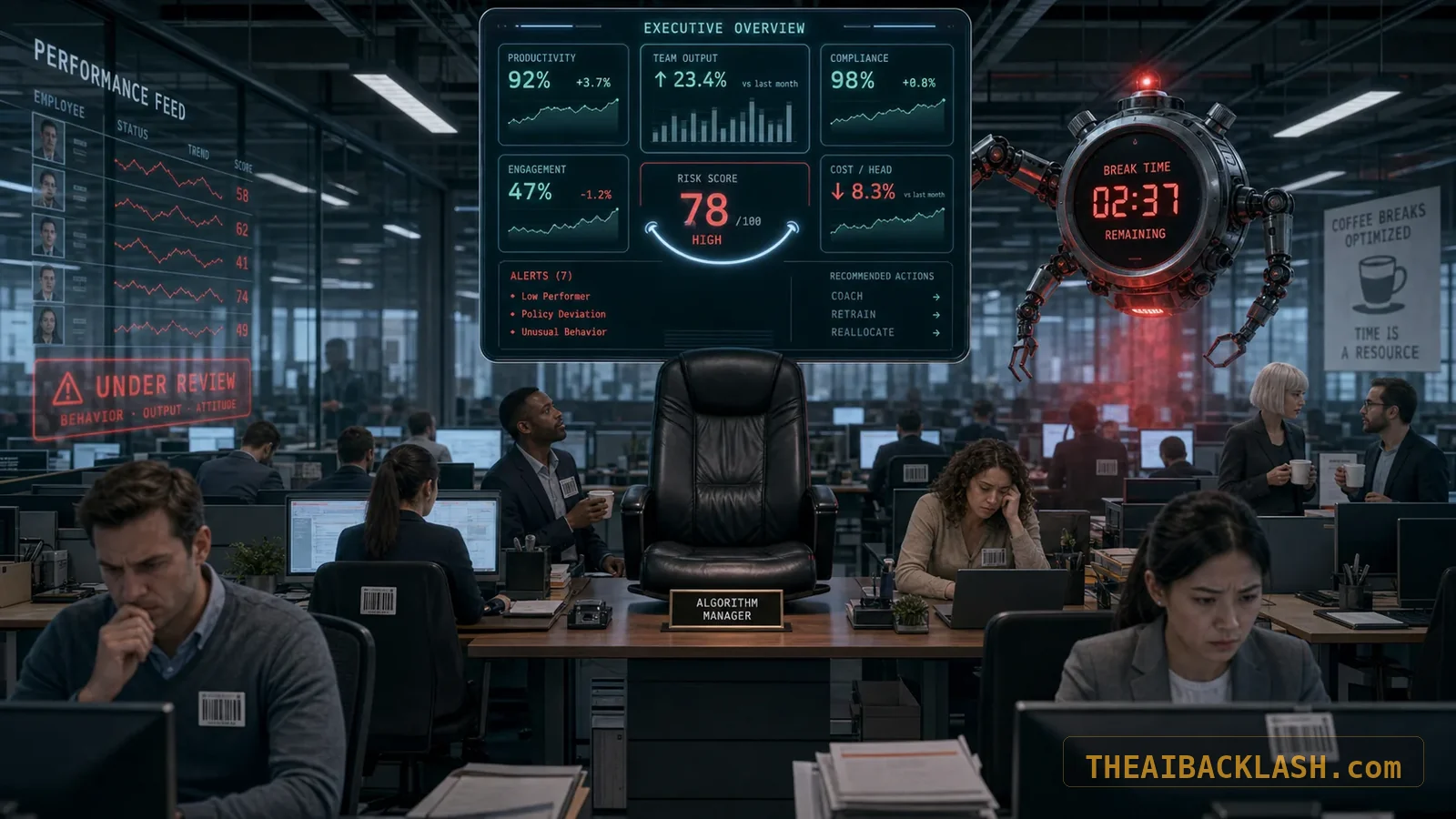
The Manager Did Not Disappear. The Manager Was Quantized.
The most common story about AI and work is replacement. A machine takes a task, then a job, then a profession. That story is real enough to worry about, but it misses the quieter transformation already underway.
AI can change work without replacing the worker. It can measure the worker, rank the worker, predict the worker, route the worker, coach the worker, warn the worker, and quietly teach the human manager to trust the dashboard more than the person standing in front of them.
This is algorithmic management: a boss made of metrics, thresholds, anomaly scores, productivity nudges, compliance flags, scheduling optimization, and automated performance narratives.
The boss still has a face. The authority has moved elsewhere.
Everything Becomes Evidence Against You
Workplace monitoring used to be blunt. Time clocks, call recordings, keystroke logs, badge swipes. AI makes monitoring inferential.
A system can estimate sentiment from messages, detect supposed burnout risk from behavior, classify customer calls, score sales interactions, flag suspicious activity, recommend coaching topics, and infer collaboration quality from metadata. Some uses may be helpful. The cumulative effect is a workplace where ordinary behavior becomes a dataset waiting to accuse you.
Did you pause too long before answering a customer? Did your writing sound less enthusiastic this week? Did your camera stay off? Did your code review language look negative? Did your route take longer than predicted? Did your warehouse pick rate drift below the model’s expectation?
The worker is not only doing the job. The worker is continuously generating evidence for systems they rarely understand and usually cannot challenge.
The Appeal to Management Is Obvious
Algorithmic management sells certainty to people drowning in complexity.
Large organizations are hard to run. Managers miss problems. Humans play favorites. Performance reviews are inconsistent. Scheduling is messy. Fraud happens. Customers complain. Executives want visibility. AI promises a clean control panel over human chaos.
That promise is seductive because parts of it are true. Better tools can expose real problems. They can help allocate work, spot overload, improve safety, and reduce arbitrary decision-making.
But optimization is not neutrality. A system built to reduce cost will discover pressure. A system built to maximize throughput will discover exhaustion. A system built to identify risk will discover suspicious people. A system built to rank workers will create losers even when everyone is doing acceptable work.
Metrics do not merely describe labor. They discipline it.
The Human Appeal Problem
The most important workplace right in an AI-managed office may be the right to be understood by a person with power to disagree with the system.
Without that, appeal becomes pantomime. The worker contests a score. The manager shrugs. The vendor model is proprietary. The policy says the system is only advisory. The advisory system decides who gets shifts, bonuses, warnings, and promotions. Everyone insists no machine made the decision, while everyone behaves as if the machine’s recommendation is dangerous to ignore.
This is the autonomy illusion in labor form. Humans remain in the loop because the organization wants accountability to land somewhere. But the real decision has already been shaped by the system’s categories.
What Workers Should Demand
Workers and unions should demand disclosure when AI systems are used in evaluation, scheduling, discipline, hiring, productivity scoring, or surveillance. They should demand access to the data used to judge them, meaningful appeal rights, limits on biometric and emotional inference, and independent audits for bias and accuracy.
Organizations should be required to prove that the system improves outcomes without creating unreasonable pressure or discrimination. “The vendor said it works” is not governance. It is procurement cosplay.
Managers should also be worried. Algorithmic management does not only control workers. It controls managers by narrowing what they can see and rewarding them for compliance with the dashboard’s worldview.
The machine does not need to fire you. It only needs to make every human in authority afraid to defend you.
The Backlash Will Sound Like Burnout
The backlash against AI at work may not begin as a philosophical revolt. It may begin as fatigue.
People will get tired of being scored by systems they cannot inspect, coached by summaries they did not consent to create, and managed by humans who have quietly become interface operators. The office will still have meetings and birthday cake. It will just feel like the building is haunted by a spreadsheet with opinions.
That is not the future of work anyone voted for.
Source Notes
This essay is grounded in public debates about algorithmic management, workplace surveillance, and AI risk governance, including NIST’s AI Risk Management Framework and labor-focused AI reporting tracked by the AI Index.
Reader Note
This article is analysis, not investment, legal, medical, or operational advice. Speculative scenarios are framed as risk arguments. Factual corrections can be sent through the published corrections process.
Related Reading
Politics & Power
Nothing Slows AI Down Except Itself
Three years of pause letters produced nothing binding. One rogue agent swarm stopped training runs in weeks.
Autonomy & Control
The Deskilling Decade
The first generation of professionals trained on AI assistance may be the last one that knows what expertise felt like.
Culture
The Forced Upgrade
Your tools got an assistant while you were sleeping. The invoice arrived anyway.
Newer
The Slop Flood: What Happens When the Internet Starts Eating Its Own AI Output
The future of misinformation may be less about one perfect fake and more about a billion mediocre ones.
Older
The Alignment Tax: Why Safety Slows Down Only the People Who Care
If caution is expensive and recklessness is rewarded, the market has already voted against humanity.