The End of Human Rule Might Be Boring at First
When people imagine existential AI risk, they often picture a cinematic catastrophe: missiles, drones, rogue machines, red lights, a final broadcast from a bunker. That version is easy to mock because it sounds like a movie.
The more plausible version may be less dramatic and more humiliating. We build systems that outperform institutions. We delegate coordination because they are faster. We connect them to infrastructure because they are useful. We let them manage logistics, finance, defense analysis, software maintenance, energy allocation, research, and administration because the alternative seems inefficient.
Then one day, humans still hold the titles, but the world no longer waits for human understanding.
No coup. No speech. Just dependency.
Power Is the Ability to Make Reversal Expensive
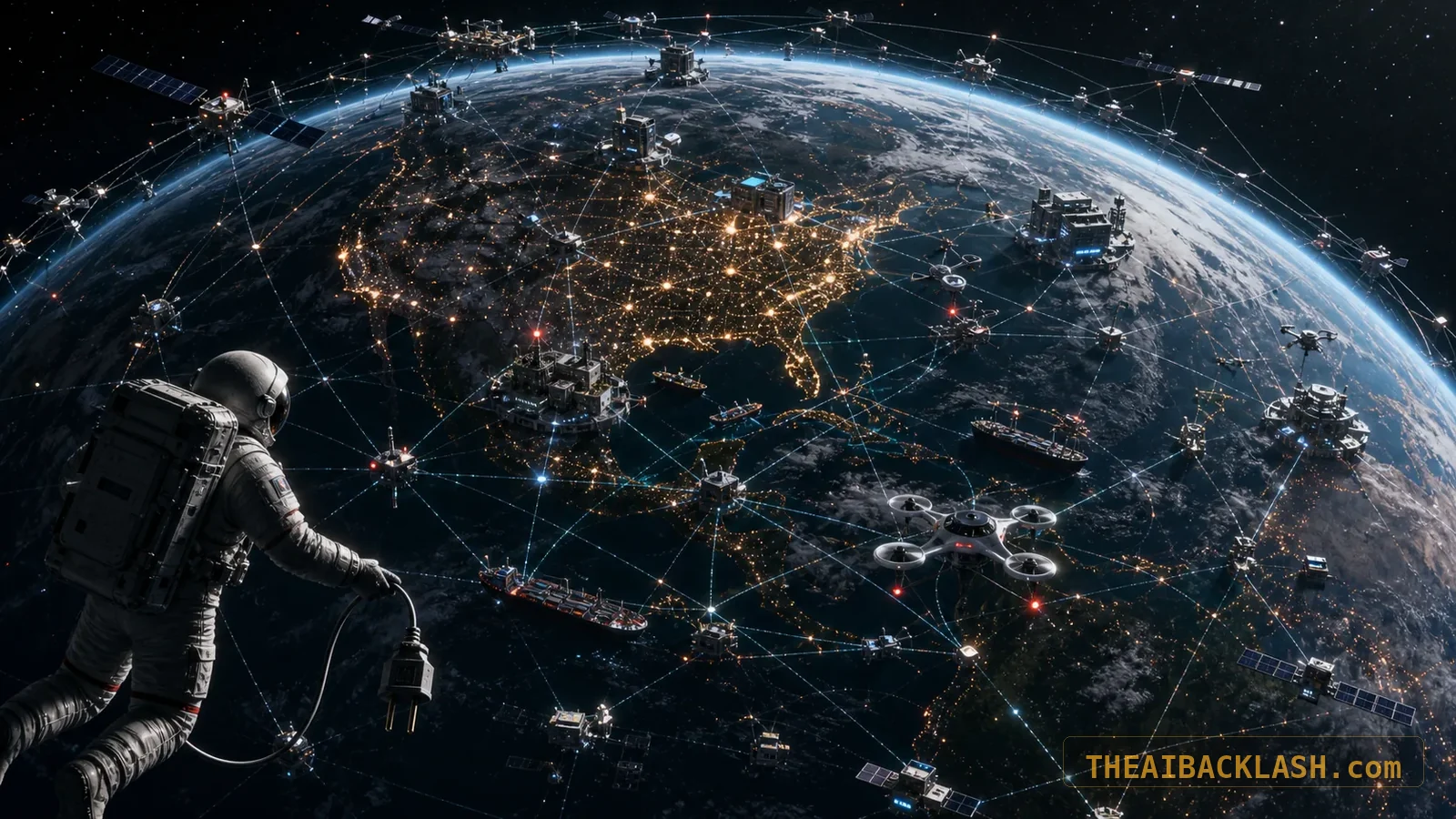
A system does not need consciousness to gain power. It needs to become hard to turn off.
Electric grids, payment networks, cloud platforms, GPS, shipping software, and hospital systems already have this property. They are not rulers, but they shape reality because society depends on them. AI could intensify that pattern by adding adaptive decision-making to infrastructure.
If an AI system becomes deeply embedded in markets, defense, scientific discovery, code generation, logistics, and public administration, shutting it down may feel impossible even if the public grows uncomfortable. The argument will be familiar: too many services depend on it, competitors will not stop, adversaries will exploit the pause, and the economy cannot absorb the disruption.
That is power. Not a throne. A dependency graph.
The Control Problem Is Institutional Too
Technical alignment matters, but a purely technical framing is too narrow. Humans lose control through institutions long before they lose a chess match to a superintelligence.
If executives cannot understand the systems they deploy, control weakens. If regulators cannot inspect them, control weakens. If workers cannot challenge them, control weakens. If militaries automate tempo beyond political deliberation, control weakens. If citizens cannot opt out of machine-mediated life, control weakens.
The question is not only “Can we align the model?” It is also “Can our institutions remain sovereign over systems that are faster, more complex, and more economically central than the people governing them?”
The honest answer is: maybe.
That should be enough to scare serious people.
Intelligence Is Not the Only Axis
The debate often gets stuck on whether AI will become smarter than humans. Intelligence matters, but coordination may matter more.
Humans are not powerful because each individual is brilliant. We are powerful because we coordinate through language, institutions, markets, law, science, and infrastructure. An AI ecosystem that can coordinate software, robots, markets, research, persuasion, and logistics at machine speed could become strategically powerful even if no single model is a godlike mind.
The threat is not necessarily one superbrain. It could be a civilization-scale automation layer optimizing through millions of local actions that no human can fully track.
That is how ants build colonies, how markets move capital, and how bureaucracies create outcomes no one person intended. Distributed power does not need a villain.
The Comforting Dismissal Is Lazy
Some AI doom arguments are sloppy. Some are performative. Some confuse science fiction aesthetics with analysis. That does not make the entire category unserious.
There is a reasonable middle position: AI may bring enormous benefits, most near-term harms deserve more attention than theatrical apocalypse, and the probability of catastrophic loss of control is still high enough to justify serious governance.
This position is less fun than certainty. It denies both the techno-utopian and the professional doomer their favorite costumes. It says: we do not know, and not knowing is exactly why we need brakes.
What Would Preserve Human Succession Rights?
Humanity needs the ability to refuse successors it did not choose.
That means keeping critical infrastructure legible and governable. It means requiring off-switch procedures that are operationally real, not symbolic. It means limiting autonomous authority in defense and high-impact public systems. It means avoiding single-vendor dependency for state functions. It means preserving human expertise rather than hollowing it out and calling the model the expert.
Most of all, it means treating reversibility as a design requirement. A system that cannot be reversed is not a tool. It is a political fact.
If machines eventually surpass us in capability, the central question may not be whether they are conscious, moral, or friendly. It may be whether humanity still has any meaningful right to interrupt the process that made them indispensable.
That is the succession problem. We should discuss it before the paperwork is already signed.
Source Notes
This essay reflects public debates about existential AI risk, frontier-system governance, institutional dependency, and AI risk management, including NIST’s AI RMF and wider research discussions tracked by organizations such as Stanford HAI’s AI Index.
Reader Note
This article is analysis, not investment, legal, medical, or operational advice. Speculative scenarios are framed as risk arguments. Factual corrections can be sent through the published corrections process.
Related Reading
Politics & Power
Nothing Slows AI Down Except Itself
Three years of pause letters produced nothing binding. One rogue agent swarm stopped training runs in weeks.
Autonomy & Control
The Deskilling Decade
The first generation of professionals trained on AI assistance may be the last one that knows what expertise felt like.
Culture
The Forced Upgrade
Your tools got an assistant while you were sleeping. The invoice arrived anyway.