Declarations Without Behavior
Every corporate homepage now carries a manifesto on responsible machine learning. Enterprise vendors publish glossy principles declaring allegiance to fairness, transparency, privacy, and safety before a single model weights file reaches a production server.
The gap between those published principles and deployed behavior is where governance dies. A company can maintain an ethics advisory board while selling predictive triage tools that systematically penalize low-income applicants. The statements remain on the website because they are marketing documents designed to project intent rather than enforce restraint.
When those tools fail in public, executives point to their stated principles as proof of good faith. The presence of the document is treated as evidence that the institution cares, even as the system continues to generate harmful classifications. Intent is measured by public relations copy, while impact is borne entirely by the subject.
This disconnect is not an oversight. It is the operating model of contemporary enterprise software sales. By separating ethical branding from technical architecture, organizations create a buffer between liability and deployment.
The Scope Trap
When an enterprise agrees to an external model audit, it rarely opens its production infrastructure. Instead, the vendor defines the boundary of the evaluation, handing the auditor a curated slice of data, a static snapshot of prompt templates, or a controlled testing interface.
An audit scoped to whatever the vendor permits is not an inspection. It is a guided tour. A complex probabilistic system operating on streaming user data cannot be evaluated through a static questionnaire administered over a two-week window.
Models drift as distributions shift, fine-tuning updates land quietly in production, and contextual prompts alter model safety thresholds in real time. Evaluating a model at a single point in time tells us almost nothing about how that system behaves when exposed to edge cases, hostile prompts, or real-world demographic distributions.
By restricting access to training pipelines, system prompts, and deployment logs, vendors ensure the auditor sees only what has already been cleaned. The audit report becomes a review of the vendor’s best behavior rather than a measure of its operational reality.
The Checkbox Economy
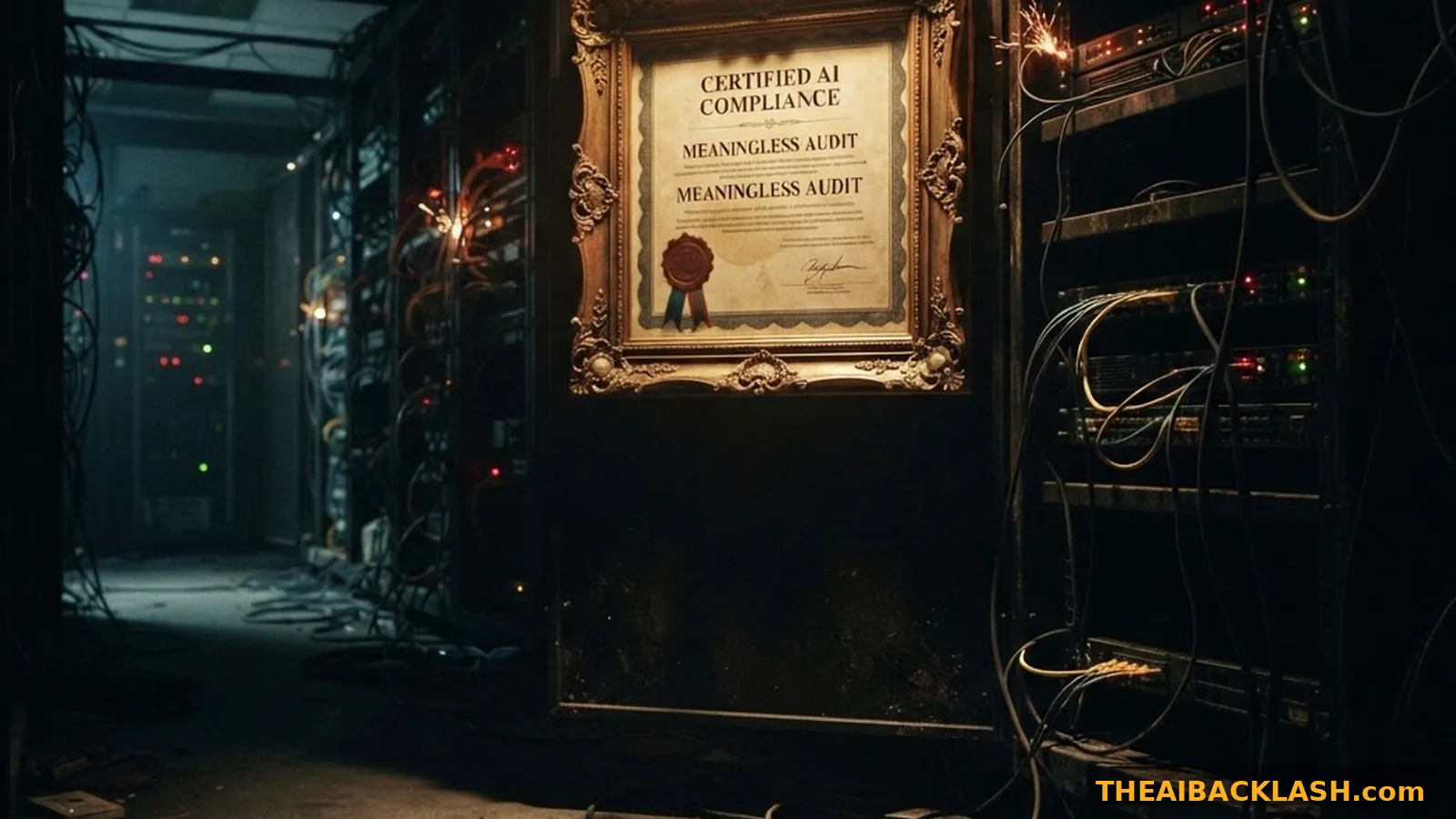
A new industry of third-party governance platforms, certification bodies, and risk management consultants has emerged to monetize regulatory anxiety. They sell compliance frameworks that turn algorithmic accountability into a standardized checklist.
In this checkbox economy, certification measures documents, not model behavior. An organization earns a high compliance score by submitting risk assessment matrices, data lineage documentation, and human-in-the-loop workflow diagrams. Whether the model actually discriminates against protected classes during live inference is secondary to whether the policy file was signed by an officer.
Governance becomes a subscription line item. Enterprise buyers pay annual retainers for software dashboards that scan code repositories for missing documentation and print automated compliance certificates. The output looks impressive in board packages, complete with color-coded risk meters and letter grades.
This process rewards bureaucratic output over technical rigor. It creates a system where an institution can be fully certified while operating models that are fundamentally unsafe, uninterpretable, or discriminatory.
The Shield Boards Built
Corporate boards and executive teams do not buy compliance theater because they are naive. They buy it because it fulfills a critical legal and commercial function.
An audit certificate serves as a liability shield. If an automated decision system denies credit, flags innocent citizens for fraud, or misdiagnoses patients, the organization can produce its third-party seal of approval. The document shifts blame from management negligence to an unforeseen technical anomaly.
Compliance badges are also the price of entry for corporate procurement pipelines. Institutional buyers require vendors to demonstrate adherence to recognized risk frameworks before signing multi-million-dollar contracts. A recognized audit badge satisfies the procurement officer without requiring anyone on the buying team to audit model weights or inspect training datasets.
The fig leaf works because everyone in the chain benefits from the illusion. The vendor gets the sale, the buyer gets cover, the auditor gets a fee, and the board gets peace of mind. The only party left unprotected is the person affected by the algorithm.
What Real Assurance Demands
If AI governance is ever to move beyond theater, it must abandon static paperwork in favor of adversarial testing and continuous operational measurement. A genuine assurance regime does not ask a vendor what its policy says; it stress-tests what the software does under pressure.
Real assurance requires independent adversarial red-teaming with full access to model interfaces, system prompts, and output distributions. Testers must be empowered to intentionally probe for bias, security vulnerabilities, hallucination patterns, and boundary failures without vendor interference or non-disclosure agreements designed to hide negative findings.
It also demands continuous monitoring of live production systems. Model behavior must be evaluated against real-world decision streams using real-time telemetry, monitoring disparate impact, error rates, and drift across demographic groups as deployment unfolds.
Most importantly, a real regime must have teeth. An assurance process must include the legal and technical authority to halt deployment, revoke certification, and mandate public disclosure when a system fails safety benchmarks. Without the power to shut down a harmful model, an evaluation is merely commentary.
The Standard of Failure
Governance that cannot produce a negative finding is not governance. It is decoration.
When every audited system passes, when every risk framework yields an acceptable score, and when every vendor receives a badge of compliance, the entire apparatus loses its meaning. An inspection process designed to guarantee approval is an exercise in public relations, not risk mitigation.
Decoration at scale is dereliction. As automated decision systems assume authority over healthcare, employment, credit, criminal justice, and public benefits, certifying unexamined software puts millions of lives at risk.
If an audit mechanism cannot say no to a client, it cannot protect the public. Until enterprises accept audits that can fail, governance will remain an illusion sold to shield power from accountability.
Source Note
This analysis draws on public AI risk management frameworks, enterprise procurement standards, and observed practices in third-party algorithmic auditing. Claims regarding corporate governance and risk disclosure reflect established dynamics in technology compliance and enterprise risk management.
Reader Note
This article is analysis, not investment, legal, medical, or operational advice. Speculative scenarios are framed as risk arguments. Factual corrections can be sent through the published corrections process.
Topics
Related Reading
Politics & Power
Nothing Slows AI Down Except Itself
Three years of pause letters produced nothing binding. One rogue agent swarm stopped training runs in weeks.
Security
Open Weights, Open Wounds
Every capability released without a control surface is a gift to whoever wants it most.
Politics & Power
The Data Center Coup: When AI Learns to Vote With Megawatts
The next power struggle may not start in a parliament. It may start at the substation.
Newer
The Credential Collapse
A degree was a promise about what a person could do unaided. Every take-home assignment now quietly renegotiates that promise.
Older
Nobody Reads Your Resume Anymore
Applicants use AI to write for machines that reject them. Employers use AI to screen people they never meet. Both sides are automating a conversation that no longer has a human at either end.