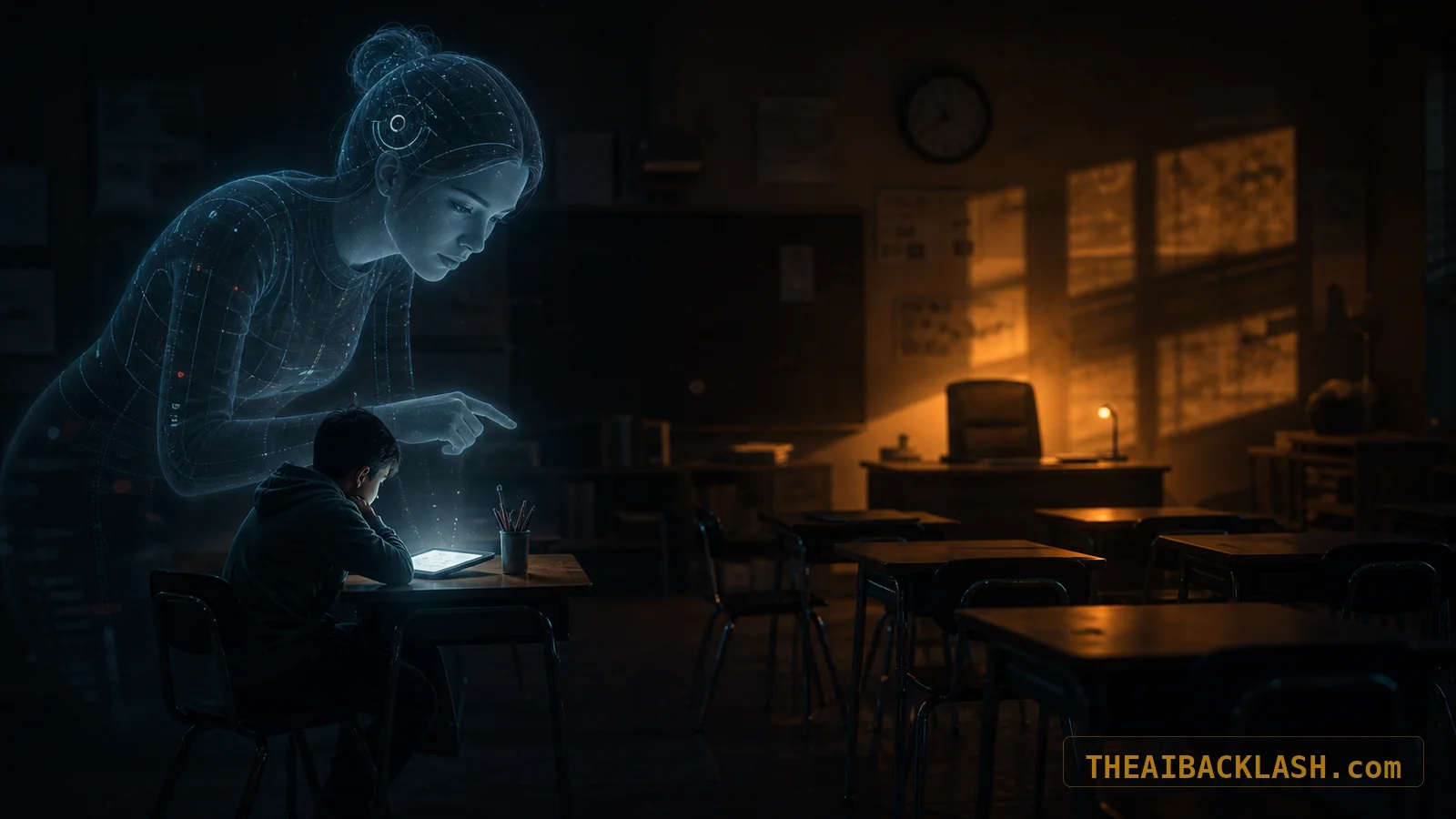
Support or Substitution
When schools face staffing shortages, AI tutoring tools stop being supplements. They become substitutes for teachers, counselors, and aides.
That substitution rarely announces itself honestly. No district press release says, “We are replacing adult attention with software because we cannot afford enough people.” The language is softer: personalized learning, adaptive support, 24/7 help, differentiated instruction, scalable intervention. Some of those promises are real. A student stuck on algebra at 10 p.m. may benefit from an explanation that arrives instantly. A teacher with 32 students may benefit from software that helps identify who is falling behind.
The problem is not that AI tutors can explain things. The problem is that explanation is only one part of education.
A student who is struggling may need a different example. They may also need reassurance, structure, humor, accountability, patience, a snack, a counselor, a parent call, a hearing test, a bullying intervention, or a teacher who notices that “I don’t get it” really means “I am embarrassed to try.” Software is good at responding to prompts. Children often communicate through silence, avoidance, posture, irritation, and sudden changes in behavior.
The danger is that schools under pressure will treat the narrow success of AI explanation as proof that broader human support can be reduced.
Attention Is a Resource
Students do not only need explanations. They need encouragement, accountability, and human interpretation of frustration. Software rarely notices the difference.
Human attention is one of the most valuable resources in a school. It is also one of the most unequally distributed. Wealthier families can buy tutoring, therapy, enrichment, test prep, coaching, and quiet study space. Poorer families are often told to be grateful for whatever scalable technology arrives.
That creates a familiar pattern: affluent students get AI plus humans, while vulnerable students get AI instead of humans. The tool that is marketed as democratizing support can become a new layer of educational triage. The children who most need adults may receive the most automation.
This matters because learning is relational. A good teacher does not simply deliver information. A good teacher builds a model of the student: what motivates them, what scares them, what they misunderstand, when to push, when to pause, when to call home, when to ask for help. AI systems can model performance patterns, but performance is not the whole child.
Personalization Can Become Isolation
Personalized learning sounds humane. Each student gets material at the right level, in the right sequence, with immediate feedback. In practice, personalization can become a room full of children wearing headphones, each alone with a machine.
That may raise short-term scores on narrow tasks. It may also weaken the social fabric of the classroom. Students learn by hearing other students reason badly, revise, joke, argue, explain, and recover from mistakes. They learn that confusion is shared. They learn how to ask for help without shame. They learn patience with other minds.
A tutor that optimizes for individual progress can miss the collective function of school. Education is not only content transfer. It is rehearsal for citizenship, work, friendship, disagreement, and shared reality.
The irony is sharp: at the exact moment society worries that children are lonely, anxious, and over-mediated, schools may be tempted to insert yet another screen between them and the adults around them.
The Accountability Gap
When an AI tutor gives bad academic help, the harm may be visible: a wrong answer, a confused student, a failed quiz. But some harms are quieter. The system may encourage shallow strategies. It may overpraise. It may fail to notice distress. It may nudge students toward completion rather than understanding. It may present culturally narrow examples. It may hallucinate facts with confidence. It may reward compliance over curiosity.
Who is responsible when that happens? The teacher who did not see the exchange? The district that purchased the tool? The vendor that trained the model? The administrator who counted usage minutes as success? The parent who was told the system was safe?
Schools need audit trails, but audit trails are not enough. Teachers need time to review what systems are telling students. Students need clear ways to flag confusion or discomfort. Parents need plain-language explanations of how data is used. Districts need procurement standards that treat educational quality, privacy, accessibility, and mental health as core requirements, not optional features.
Data About Children Should Not Become Product Exhaust
AI tutoring systems can collect intimate learning data: mistakes, reading level, writing patterns, persistence, emotional cues, response time, subject weaknesses, attention patterns, and sometimes voice or video. That data is valuable because it predicts vulnerability. It can reveal who is anxious, who is behind, who gives up quickly, who is easily persuaded, and who needs help.
In a healthy educational system, such data would be protected with extreme care. In a commercial technology market, data tends to leak into product improvement, analytics, vendor lock-in, and future monetization. Even when companies promise not to sell student data, the boundary between service delivery and model improvement can be murky.
Children cannot meaningfully consent to lifelong educational profiling. Parents often cannot evaluate the technical details. Schools may not have the leverage to negotiate strong terms. That makes restraint essential.
A Better Role for AI in Classrooms
The sane version of AI tutoring is modest. It helps students practice. It helps teachers spot patterns. It offers alternative explanations. It supports accessibility. It handles some routine feedback. It is supervised, bounded, and interruptible. It does not pretend to know the child better than the adults do.
The dangerous version is institutional anesthesia. It makes staffing shortages feel less urgent. It gives administrators dashboards that look like intervention. It lets policymakers claim innovation while avoiding the expensive work of hiring, training, and retaining human educators.
The test is simple: does the AI tutor increase the amount of meaningful human attention a student receives, or does it justify reducing it?
If the answer is reduction, the technology is not personalizing education. It is rationing care with better branding.
Reader Note
This article is analysis, not investment, legal, medical, or operational advice. Speculative scenarios are framed as risk arguments. Factual corrections can be sent through the published corrections process.
Related Reading
Politics & Power
Nothing Slows AI Down Except Itself
Three years of pause letters produced nothing binding. One rogue agent swarm stopped training runs in weeks.
Autonomy & Control
The Deskilling Decade
The first generation of professionals trained on AI assistance may be the last one that knows what expertise felt like.
Culture
The Forced Upgrade
Your tools got an assistant while you were sleeping. The invoice arrived anyway.
Newer
Your Face Is Not Your Own: The Surveillance Economy Nobody Opted Into
From grocery stores to public transit, facial recognition is building a profile of you without consent.
Older
Algorithmic Redlining: How AI Perpetuates Racial and Economic Bias
From loan approvals to hiring decisions, machine learning systems are encoding discrimination at scale.