Latency as Doctrine
The strategic argument for AI in warfare is usually speed. That same speed leaves less room for skepticism, context, and restraint.
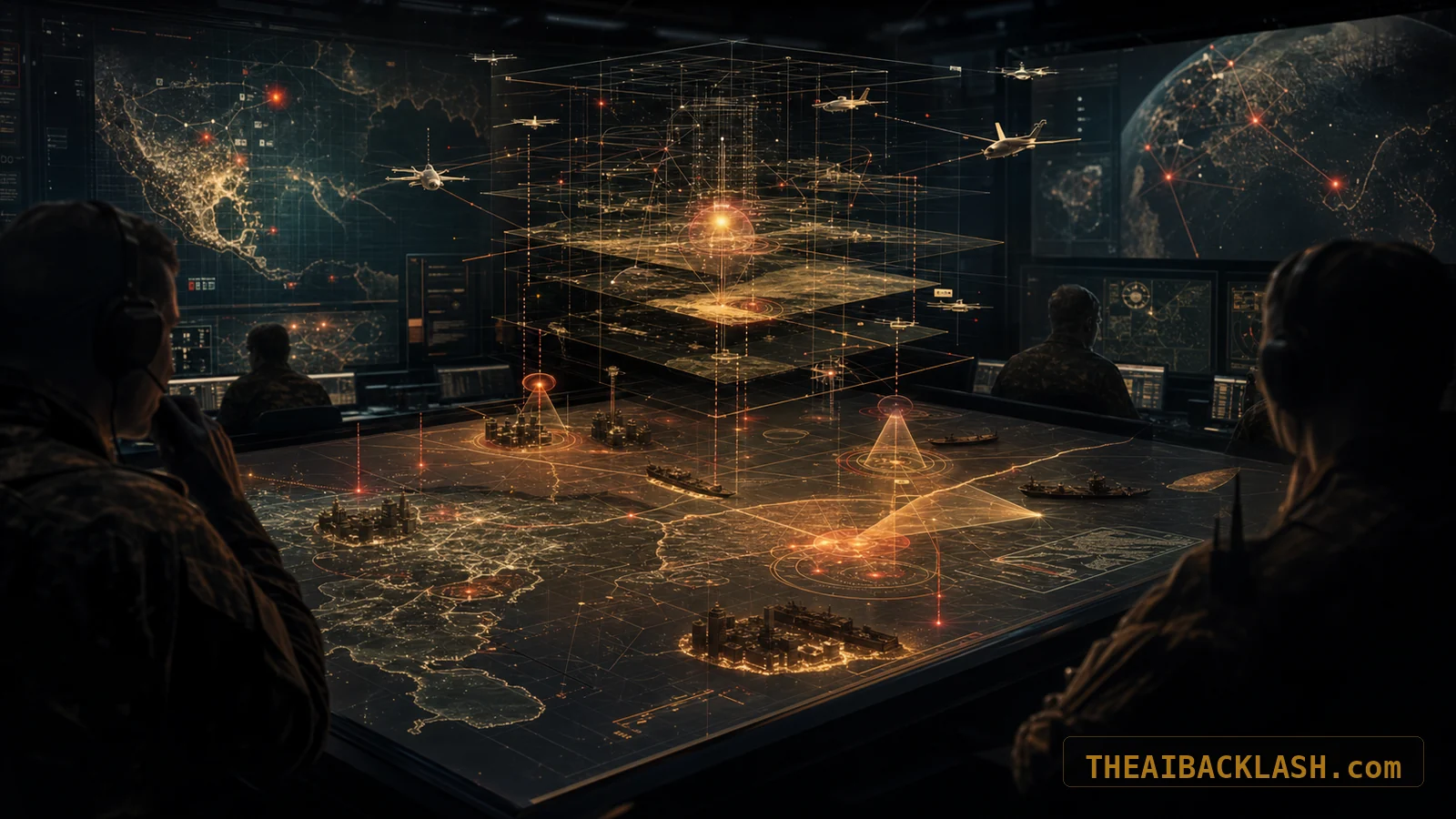
War is a machine for producing uncertainty. Sensors fail. Adversaries deceive. Civilians move. Weather changes. Communications break. Commanders misunderstand. Intelligence arrives late, partial, and politically shaped. In that environment, the appeal of AI is obvious: fuse more data, find patterns faster, recommend action before the enemy can react.
But speed is not wisdom. A model can identify a vehicle pattern, communications cluster, heat signature, or supply route that resembles prior hostile activity. It cannot fully understand surrender, coercion, panic, local custom, faulty intelligence, or the political meaning of a strike. The map is not the territory, and the model is not the battlefield.
The risk is not that military AI will be useless. The risk is that it will be useful enough to trust too much.
Oversight After Deployment
Public oversight tends to arrive after capabilities are embedded into procurement and doctrine. By then, the political cost of reversal is high.
Modern militaries already prize decision speed. The side that sees first, decides first, and acts first may gain advantage. AI intensifies that logic. It promises faster intelligence analysis, faster target nomination, faster drone coordination, faster cyber operations, faster logistics, and faster command recommendations.
At some point, the human role can shrink from judgment to permission. A system flags. Another system prioritizes. Another recommends. A commander approves under time pressure. The loop remains technically human, but operationally automated.
That compression matters because escalation often happens through ambiguity. A radar return, satellite image, troop movement, or cyber anomaly may have multiple interpretations. A slower process allows diplomacy, cross-checking, and doubt. A faster process may convert uncertainty into action before anyone has time to ask whether the signal means what the system says it means.
The Target Is a Category Before It Is a Person
AI targeting systems depend on classification. They sort the world into objects, behaviors, probabilities, and risk categories. That process can be powerful, but it is morally dangerous.
A person becomes a pattern. A building becomes a node. A phone becomes an association. A movement becomes intent. The system may never say “kill this person.” It may say “high-value target probability,” “hostile activity signature,” or “priority engagement candidate.” Bureaucratic language creates distance from the human consequence.
The danger grows when targets are inferred through networks. If a model weighs proximity, communications, travel patterns, or shared devices, civilians can become legible as threats because war has made ordinary life suspicious. In conflict zones, people borrow phones, share vehicles, gather near infrastructure, move unpredictably, and interact with armed actors under coercion. A model trained on patterns may miss those realities.
Autonomous Weapons Are Not the Only Issue
Public debate often focuses on fully autonomous weapons: systems that can select and engage targets without human intervention. That debate is essential. But a narrower focus can miss the broader transformation already underway.
AI can shape war without pulling the trigger. It can decide what intelligence analysts see first. It can recommend which targets deserve review. It can rank threats. It can generate operational plans. It can forecast unrest. It can allocate surveillance. It can write summaries that frame command decisions.
These support functions may be less visible than killer robots, but they can still determine life and death. If a model controls attention, it controls the menu of possible action. What is not surfaced may not be considered. What is ranked high may feel urgent. What is summarized badly may be misunderstood.
Accountability After Algorithmic Harm
Military organizations are hierarchical, but AI can blur accountability. If a strike based partly on model output kills civilians, who is responsible? The commander? The analyst? The procurement office? The vendor? The data team? The policy official who approved deployment? The answer cannot be “the model,” because models cannot be punished, deterred, or morally educated.
This is not an abstract concern. Accountability depends on records: what data was used, what the system recommended, what confidence it expressed, what alternatives existed, who reviewed it, who dissented, and whether known limitations were ignored. If military AI systems are classified black boxes even inside the chain of command, after-action review becomes theater.
A lawful system is not only one that performs well. It is one whose decisions can be reconstructed, challenged, and judged.
Arms Races Punish Restraint
The strategic problem is that caution can look like weakness. If one state believes rivals are automating command, surveillance, cyber operations, or drone swarms, it may feel pressure to do the same. Safety reviews, legal constraints, and human oversight can be portrayed as delays. The alignment tax appears on the battlefield too: the actor willing to accept more risk may move faster.
That dynamic is how unstable systems spread. Nations may deploy tools before they are well understood because the alternative appears to be falling behind. Vendors may oversell capabilities. Commanders may adapt doctrine around tools whose failure modes remain unclear. Once integrated, systems become hard to remove.
The Case for Hard Limits
Military AI needs more than ethical principles. It needs enforceable limits.
Some functions should require meaningful human control by law and doctrine, especially target selection and lethal engagement. Systems should be tested under adversarial conditions, not only clean benchmarks. Commanders should receive training on automation bias. Logs should be preserved. Civilian harm assessments should include algorithmic contribution. Vendors should be accountable for known defects. International agreements should restrict systems that cannot comply with humanitarian law.
Just as important, militaries should preserve the right to be slow. Not every advantage is worth taking. In nuclear, cyber, and conventional conflict, compressed decision time can be civilization-level danger. A system that wins minutes in a tactical loop may lose the strategic space needed to avoid catastrophe.
The most dangerous military AI will not announce itself as a rogue machine. It will arrive as efficiency, situational awareness, and decision support. It will promise clarity in the fog of war. The question is whether human beings will remember that the fog is not a bug in war. It is the condition under which moral judgment matters most.
Reader Note
This article is analysis, not investment, legal, medical, or operational advice. Speculative scenarios are framed as risk arguments. Factual corrections can be sent through the published corrections process.
Topics
Related Reading
Politics & Power
Nothing Slows AI Down Except Itself
Three years of pause letters produced nothing binding. One rogue agent swarm stopped training runs in weeks.
Security
Open Weights, Open Wounds
Every capability released without a control surface is a gift to whoever wants it most.
Autonomy & Control
Agents With Hands: When the Browser, Wallet, and Inbox Start Acting Without You
The scary part of agentic AI is not that it talks like a person. It is that it can click like one.