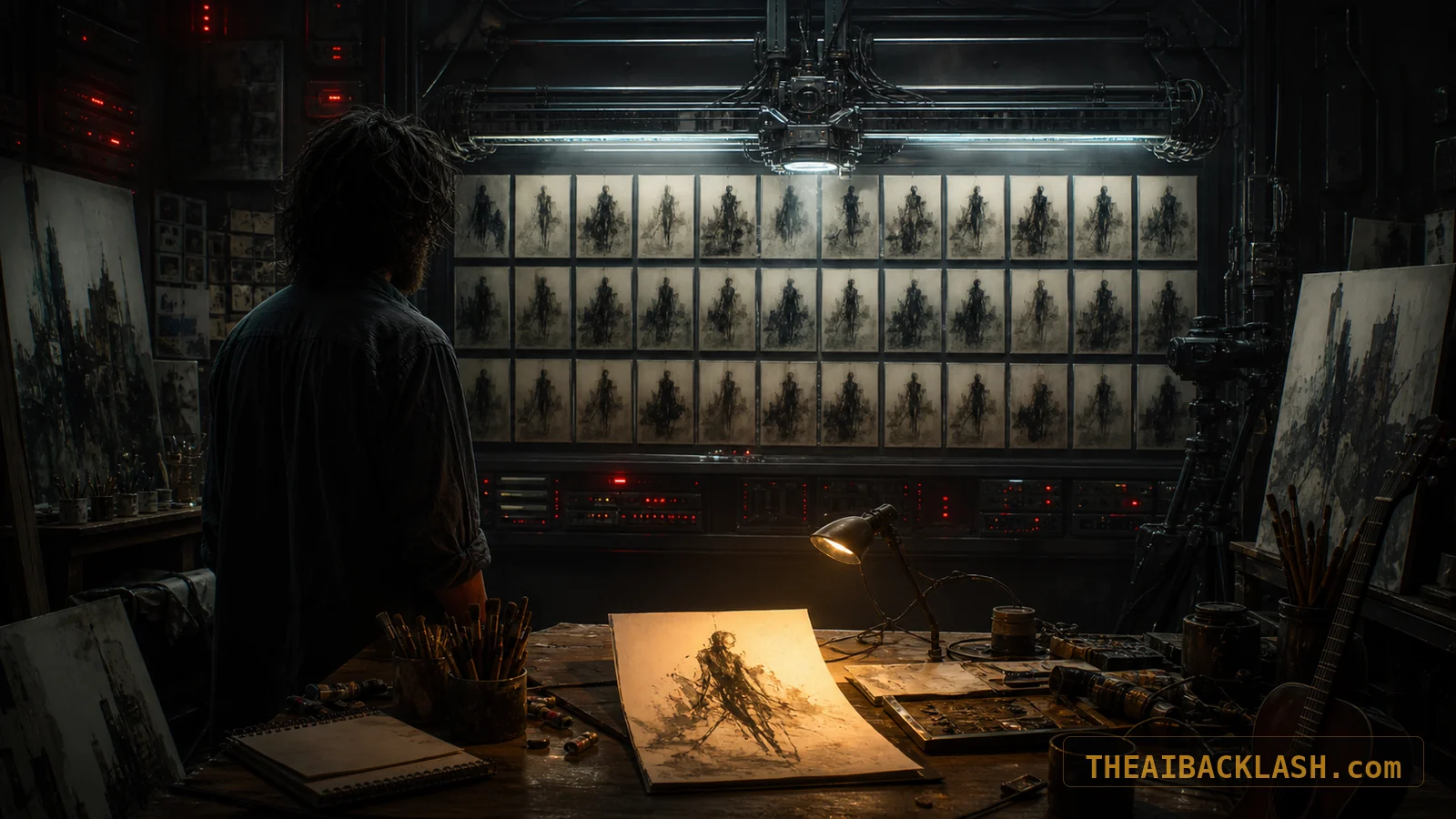
Abundance Without Context
Machine-generated content produces quantity at unprecedented scale, but cultural value still depends on context, identity, and intent.
The first shock of generative AI was output. Images, songs, scripts, logos, voices, pitch decks, poems, product photos, character designs, lesson plans, and ad concepts appeared in seconds. The second shock is harder to measure: the collapse of context.
Art has never been only the artifact. It is the hand, risk, history, obsession, constraint, community, and argument around the artifact. A painting is not only pigment. A song is not only waveform. A novel is not only word sequence. Culture matters because people make things from inside lives that can be wounded, changed, embarrassed, surprised, and accountable.
Generative systems can imitate the surface of that process without inhabiting it. They can produce the look of grief without grieving, the sound of protest without risking arrest, the style of a subculture without belonging to it, and the polish of craft without apprenticeship. That does not make the output worthless. It makes the cultural transaction different.
Markets Punish Friction
Creative labor becomes harder to sustain when automated outputs undercut the price of entry-level and mid-tier work.
The creative economy has always been uneven, but it depended on ladders. Junior illustrators, copywriters, editors, designers, musicians, animators, photographers, and production artists learned through lower-stakes work. They made mistakes, built portfolios, developed taste, found collaborators, and gradually moved toward more original work.
AI attacks the ladder first. It does not need to replace the famous artist. It only needs to absorb the budget for the junior concept pass, the stock illustration, the first draft, the background asset, the internal mockup, the temp voiceover, the cheap jingle, the editorial image, the social post, the explainer graphic. Each task looks small. Together, they are the training ground.
When markets punish friction, they punish becoming. The work that teaches artists how to be artists gets labeled inefficient.
Style Without Permission
The conflict over training data is not only legal. It is existential. Artists see systems that can imitate recognizable styles after ingesting vast amounts of human work. Companies describe this as learning. Artists experience it as extraction.
The debate often gets trapped in extremes. Humans learn from other humans, yes. Artists borrow, transform, parody, quote, and remix. But human influence is not the same as industrialized style capture. A person studying a painter spends time, fails, develops interpretation, and remains a bounded competitor. A model can absorb patterns at scale and produce infinite near-substitutes for clients who wanted the painter’s look without the painter’s price.
The question is not whether influence should exist. The question is who gets power when influence becomes automated, searchable, and commercial at global scale.
The Flood Changes Taste
Abundance changes audiences. When every feed is saturated with competent images, catchy loops, synthetic voices, and polished paragraphs, attention becomes more defensive. People skim faster. They trust less. They reward novelty, outrage, or hyper-specific identity. The middle fills with sludge.
That has consequences for human artists. The problem is not only competition. It is atmosphere. A real photograph has to compete with synthetic spectacle. A careful essay has to compete with infinite summaries. A musician has to compete with mood tracks generated for every micro-genre. A designer has to explain why judgment matters when a client can generate 200 options before lunch.
The market may still prize great art, but it can become brutal to everything below celebrity or luxury status. Culture becomes polarized between bespoke human authenticity and disposable machine abundance.
Human Work as Luxury
One possible future is that human-made art survives as premium craft. People may pay more for the verified human, the live performance, the signed object, the local scene, the artist with a story. That sounds comforting until you notice what it implies: human expression becomes a luxury category.
If ordinary creative work is automated and human-made work becomes boutique, fewer people get to make a living developing their voice. Culture narrows. The pipeline favors those with independent wealth, institutional access, or existing audience power. Everyone else is told to use the tools and adapt.
Adaptation will happen. Artists are already using AI for references, drafts, editing, exploration, and production support. The question is whether adaptation expands human possibility or merely teaches artists to supervise the systems that displaced their income.
What Defending Artists Actually Means
Defending artists does not mean banning technology or pretending every generated image is empty. It means building markets and laws that recognize consent, compensation, attribution, and bargaining power.
Artists should have meaningful ways to opt out of training uses, license work collectively, audit misuse, and challenge style impersonation that harms their market. Creative clients should disclose when AI is used. Platforms should label synthetic work without burying human work. Institutions should fund human commissions, local arts, and apprenticeships precisely because markets may stop doing it on their own.
Most importantly, audiences need to recover a taste for origin. Not every image has to be human-made. Not every draft needs a soul. But some work matters because a person made choices under constraint and stood behind them.
The last artists will not be the last people capable of making images or songs or stories. They may be the last people who remember that culture is not output. It is a relationship between makers, audiences, memory, and risk. If we lose that, the machines will not have killed art. We will have discounted it until only the simulation was affordable.
Reader Note
This article is analysis, not investment, legal, medical, or operational advice. Speculative scenarios are framed as risk arguments. Factual corrections can be sent through the published corrections process.
Topics
Related Reading
Politics & Power
Nothing Slows AI Down Except Itself
Three years of pause letters produced nothing binding. One rogue agent swarm stopped training runs in weeks.
Autonomy & Control
The Deskilling Decade
The first generation of professionals trained on AI assistance may be the last one that knows what expertise felt like.
Culture
The Forced Upgrade
Your tools got an assistant while you were sleeping. The invoice arrived anyway.